
Nikro Air Duct Cleaning in Brea: A Homeowner’s Guide
A Nikro unit can move serious air, and that’s exactly where the trouble starts. We’ve watched a crew park a 3,000 CFM negative air machine at the wrong access point in a Brea zoned system, flip the switch, and pull contaminated air backward through sections of duct that never got cleaned at all. The equipment was professional. The execution wasn’t. This guide is about the gap between owning Nikro machines and knowing how to run them inside a real Southern California duct system, so you can ask the right questions before you hire.
If you’d rather skip the homework and have someone who does understand the equipment take a look, call (866) 947-9306 for a free estimate.
What does Nikro equipment actually do at each stage of a duct cleaning job?
Nikro’s negative air machines and HEPA-filtered vacuums do specific jobs at specific moments, and each stage depends on the one before it. A portable Nikro negative air unit typically pulls somewhere around 3,000 CFM of air through a sealed duct system while HEPA filtration captures what comes loose. The sequence is the whole point. Run it out of order and you’ve moved dust around a Brea house without removing it.
A properly run job usually looks like this:
- System survey and pressure mapping. The technician identifies every branch, the return path, and where the system zones split. In two-story Brea homes with separate upstairs and downstairs runs, this step decides everything that follows.
- Access cutting and sealing. Access holes go into trunk lines at calculated points, then get sealed with the machine connected. If those seals leak, the negative pressure you paid for escapes into the attic or wall cavity instead of pulling from the rooms.
- Negative pressure established. The Nikro unit is connected so the whole duct system sits under vacuum. Air must travel inward toward the machine, not outward toward your living room.
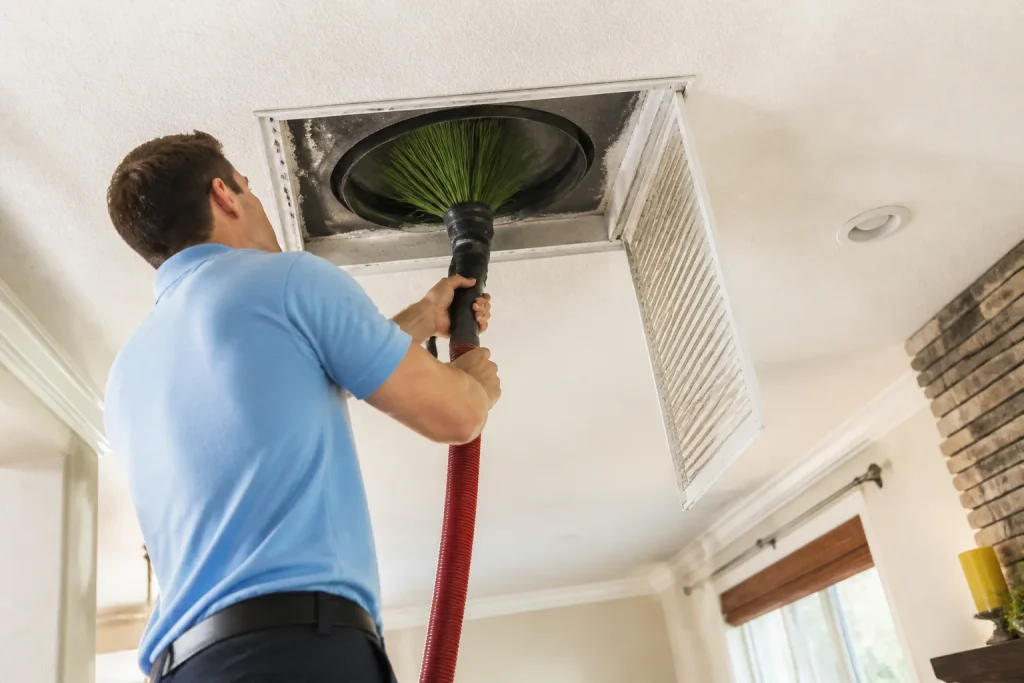
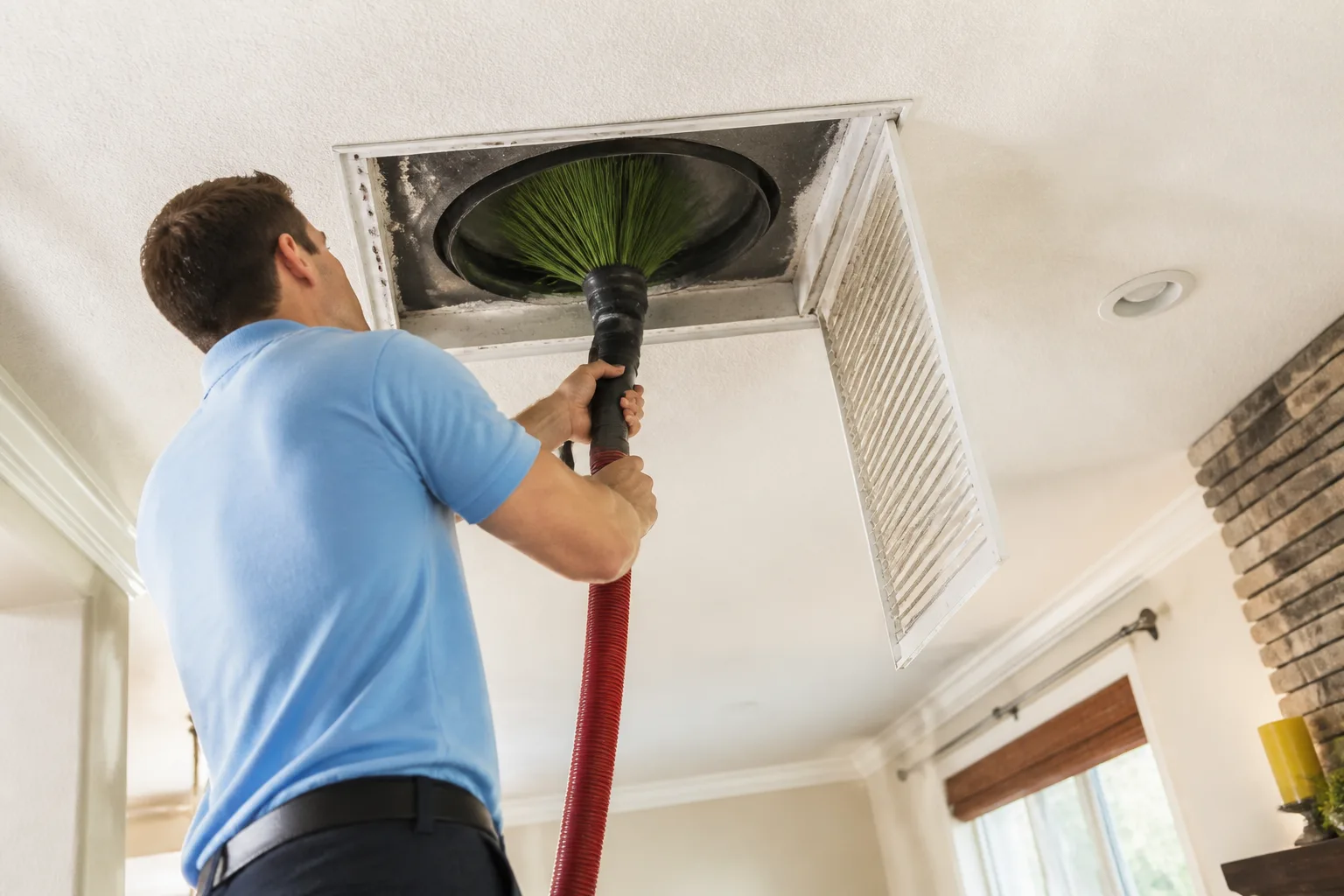
- Agitation, section by section. Compressed air whips and rotary brushes break loose the caked-on debris that vacuum alone won’t lift. This is the part that requires the technician to actually be in the rooms, not standing next to the machine.
- HEPA capture and final verification. The HEPA filter traps what’s been freed, and the technician checks the system visually through the access points before sealing up.
Step 2 and step 3 are where most problems hide. A machine running hard against a poorly sealed system is just noise.
Portable Nikro units vs. truck-mount systems: which fits a Brea home?
Portable Nikro units and truck-mount systems solve different problems, and neither is universally better. Truck-mount equipment brings enormous suction and a large hose, but the hose has to reach the ductwork, which means it runs through a door or window and limits where it can connect. Portable Nikro units go where a truck cannot, which matters a lot in Brea’s denser neighborhoods and in homes with awkward attic or crawlspace access.
Where each tends to fit:
- Truck-mount systems work well on larger, straightforward duct runs with easy exterior access, and they move a high volume of air quickly.
- Portable Nikro negative air machines handle zoned systems, multi-story layouts, tight access points, and homes where stringing a hose through the house isn’t practical. They’re also the practical choice when the work has to happen section by section.
- HEPA-filtered portable vacuums suit the finer work: register-level cleaning, return grilles, and finishing passes where you don’t want dust escaping into the room.
In our experience across air duct cleaning work in Brea, most single-family homes here have duct configurations that reward the portable, section-by-section approach. Knowing which tool the job calls for is the first sign of a careful contractor. Owning both and using the right one is the second.
How do you verify a technician is using Nikro equipment correctly?
You can verify correct equipment use by watching three things: where the access points go, whether agitation happens in every room, and whether the technician sequences the pressure properly. You don’t need to know the machine’s model number. You need to see that the person operating it understands what the machine is doing.
Here’s what to look for:
- Access point placement. A skilled technician calculates where to cut into the trunk line so the whole system sits under vacuum. Random holes near the nearest register are a warning sign.
- Agitation coverage. Every branch should get mechanical agitation, room by room. If the technician never enters half the rooms in the house, half the ductwork didn’t get cleaned.
- Pressure sequencing. The system should be sealed and under negative pressure before agitation begins. If the machine runs before the seals are set, contaminated air is being pushed, not captured.
- Zoned system awareness. Brea homes with separate heating and cooling zones need each zone handled deliberately. A contractor who ignores the zone dampers can leave one side of the house untouched.
- HEPA verification. Ask to see the filtration setup. A HEPA filter that’s overloaded or missing isn’t capturing anything.
When to call a pro: if your home has multiple zones, a history of allergy complaints, or you’ve never had the ducts opened up, this isn’t a project to hand to a shop vacuum and a Saturday. It’s also worth noting that the team at Brea Air Duct Cleaning Pros can answer equipment questions directly before you book anything.
What Nikro equipment cannot do for your Brea home
Nikro equipment cleans ductwork, and that’s precisely where its job ends. It doesn’t reconnect a duct that has separated in the attic, seal a leaking joint, repair crushed flex line, or treat mold at its source. A strong negative air machine can make a system look clean while the underlying problems sit untouched in the walls.
The gaps that cleaning alone leaves open:
- Disconnected or torn ducts. Common in older Brea homes where flex duct has pulled loose at a joint. Cleaning the duct upstream of a break doesn’t help what’s downstream.
- Leaking seams and joints. Every leak bleeds conditioned air into the attic or crawlspace and pulls unfiltered air back in. Sealing is a separate job from cleaning.
- Mold at the source. If moisture is feeding growth inside the system, sanitizing and moisture control come before or alongside the cleaning.
- Air filtration and quality hardware. Filtration media, humidifiers, and air cleaners are added equipment, not something a vacuum installs on its own.
This is why a full-system approach matters. Duct repair and sealing is a named service here, not something you have to hunt down a second contractor for. Our technicians have up to 11 years of experience, and the treatments we apply use Guardsman-grade cleaning and protection products. For filtration upgrades, we install recognized hardware from Honeywell, Aprilaire, and Abatement Technologies, so the improvement outlasts the cleaning visit.
Related services in Brea: dryer vent cleaning and HVAC cleaning round out the same full-system picture.
Questions to ask any Brea contractor about their equipment
The right questions reveal whether a contractor understands their Nikro machines or just happens to own them. Ask these before you book, and listen for specifics. A crew that knows the equipment answers in process terms. A crew that doesn’t answers in sales terms.
- “Walk me through how you’ll set negative pressure in my system.” A real answer mentions access point placement, sealing, and the order of operations. A vague answer tells you plenty.
- “How do you handle a zoned system?” If your Brea home has separate upstairs and downstairs zones, this question separates careful contractors from hurried ones.
- “What happens if you find a disconnected or leaking duct during cleaning?” The best answer includes repair and sealing as part of the same job. The weakest answer is “that’s a different contractor.”
- “Do you use HEPA filtration, and can I see the setup?” Anyone serious about the equipment will show you.
- “Which machine will you bring, and why?” Portable Nikro versus truck-mount should be a decision made from your duct layout, not from what’s parked outside.
- “Can you show me before-and-after photos when you’re done?” Photos of your own ducts, not a stock gallery, tell you the work actually happened.
One flat price per system, agreed before work starts, is the other thing to confirm. No per-vent pricing, no coupon that turns into a bigger invoice once the technician is on site. That’s the pattern to avoid, and the questions above are how you avoid it.
The Bottom Line
Nikro is a professional platform, not a magic word. The equipment only performs when the person running it understands access point placement, pressure sequencing, agitation coverage, and the limits of what cleaning alone can fix. Before you hire anyone in Brea, ask how they’ll set up the job, and check whether duct repair, sealing, and air quality treatment are part of their scope or somebody else’s problem.
- Around 3,000 CFM of negative pressure is only useful when it’s sealed and sequenced correctly.
- Portable Nikro units suit zoned and tight-access homes; truck-mounts suit large, simple runs.
- Cleaning doesn’t reconnect, seal, or treat mold. Repair and sealing are separate, necessary steps.
- Filtration hardware from Honeywell, Aprilaire, and Abatement Technologies keeps the improvement going.
- Ask equipment questions. The answers tell you more than any brochure.
If you’re in Brea and need help, Brea Air Duct Cleaning Pros offers free estimates. Call (866) 947-9306. We answer 24/7. Fast dispatch from 7am to 7pm, Sunday through Friday. The local pro who arrives is licensed and insured as the state requires, works to one flat price per system agreed before the job begins, and can show you before-and-after photos of your own ducts when the work is done. Dryer vent fire risk, HVAC cleaning, duct repair and sealing, and sanitizing all fall under the same visit if your system needs it.
Frequently Asked Questions
Nikro makes professional-grade negative air machines and HEPA vacuums, and they perform well when operated correctly. The brand isn’t the deciding factor. Access point placement, sealing, agitation coverage, and pressure sequencing matter more than the label on the machine. Call (866) 947-9306 for an exact quote on your Brea system; estimates are free.
Cleaning helps only if buildup is the cause. If your Brea home has leaking or disconnected ducts, cleaning alone won’t restore efficiency, and repair and sealing may be needed. A proper assessment identifies which problem you actually have. Call (866) 947-9306 for an exact quote; estimates are free.
Because strong suction at the wrong access point pulls contaminated air backward through sections that never get cleaned. Zoned systems need each zone handled deliberately, with the machine connected where the vacuum draws from the whole system, not just part of it. Call (866) 947-9306 for an exact quote; estimates are free.
There’s no single schedule that fits every home. Dust and debris accumulate at different rates depending on your HVAC use, filtration quality, and whether ducts leak. An assessment tells you more than a calendar does. Call (866) 947-9306 for an exact quote; estimates are free.
Written by the team at Brea Air Duct Cleaning Pros.
Need Air Duct Cleaning Help?
Call Brea Air Duct Cleaning Pros - the local pro we connect you with is licensed and insured, here with fast help in Brea.
(866) 947-9306